


25 February 2026 – Mombasa: Hansa’s Childhood City
The next day we hired a private van driven by Saidi for a full Mombasa tour. We left after breakfast and, after about an hour’s drive, entered the city.
That first feeling on arriving in Mombasa was unforgettable. The sight of the people, the traffic, the red soil, and even its distinctive smell made the city feel instantly alive. Kenya has a scent of its own, and for those who knew it in childhood, it can stir memories that have slept for decades.
For Hansa, this was a particularly emotional day. She had been born in Mombasa in 1954 and had lived there as a child with her parents and her brothers Kanubhai, Girish, and Kishor. Her sister Sarla was later born in India. We began where memory itself began for her: the Makupa area.
Our first stop was the Shree Radha Krishna Temple in Makupa. The area was gated and guarded by security. Hansa had been born around there. She tried very hard to remember where exactly their house had stood, but over the years many old houses had been demolished and new buildings had risen in their place. It was disappointing for her not to be able to identify the house where she had lived as a child. That kind of disappointment is familiar to anyone returning after half a century: memory holds a picture, but the city has moved on.
The temple itself, however, was still there. The same idols remained, even if the surroundings had changed. We learned that the temple had been built in 1929. Hansa’s mother used to perform seva in this same temple during the 1960s. Kanubhai and Hansa would pick flowers and make garlands for the idols before going to school.
The nearby houses were now inhabited mostly by local residents, and there was a large Somali population in the area. Hansa’s father had worked for the railways, and the district known as Railway Landi had been allocated to railway employees and their families. That historical connection was deeply meaningful to us, because railways were not just part of our family stories — they were part of the wider story of Indians in East Africa.
After taking photographs at the temple, we headed for one of Mombasa’s famous landmarks: the great man-made elephant tusks that cross the road. They still stood impressively over the street, just as they had in the past. The city centre still looked astonishingly old in places, full of colonial-era buildings and reminders of old Mombasa. We had expected to see a city transformed by high-rise modernity, but that was not entirely the case. Much of old Mombasa still seemed to carry the architecture and soul of another era.
From there, we went in search of Hansa’s school. We found Bondeni Girls School, and the moment was deeply emotional for her. The school was closed because it was mid-term holiday, but we were able to go in and take photographs. She remembered that in the 1960s there had been open ground in front of the school, with no buildings there at all. Now the whole area looked completely different, heavily built up and changed beyond easy recognition.
After that we drove through the streets of Mombasa, simply looking, remembering, and filming what we could. We passed the old railway station from where people once travelled in the old days. This too stirred emotion, for the railways shaped so much of the history of East Africa and of our own community. We then visited the ruins of Fort Jesus, built by the Portuguese more than four hundred years ago. Fort Jesus stands as one of the most important monuments on the East African coast, a reminder of the centuries of trade, conquest, and cultural crossing that shaped Mombasa. Portuguese, Arab, African, Indian, and later British influences all met in this old port city. To walk there is to walk through layers of history.
From Fort Jesus we crossed through the old streets of Mombasa to the old sea port where ships once arrived. This was an especially emotional place for me. It was from this very port that I had travelled to Mumbai — then Bombay — by ship called the S.S. Kampala in 1965, and returned by the same ship in 1969. I was only twelve years old at the time. To stand there again as an older man, remembering that young boy at the port, was deeply moving.
After that visiting the bustling markets of Mombasa was an experience that captures the city’s lively spirit and coastal culture. One of the most famous markets is Marikiti Market, where locals gather daily to buy fresh fruits, vegetables, spices, and seafood. As you walk through the crowded aisles, you are surrounded by bright colors, the scent of tropical produce, and the lively calls of vendors advertising their goods.
The market is especially known for its piles of coconuts, mangoes, pineapples, and aromatic spices that reflect the rich Swahili and Indian influences of the region. Vendors arrange their goods in neat baskets and colorful displays, creating a vibrant atmosphere that feels both chaotic and welcoming. It’s not just a place to shop—it’s a social hub where people meet, bargain, and share stories.
Exploring a Mombasa market also offers a glimpse into everyday life along Kenya’s coast. Visitors often enjoy chatting with friendly sellers, tasting fresh fruits, and discovering handmade items or local snacks. The experience is lively, authentic, and full of energy, making it one of the most memorable ways to connect with the culture of Mombasa.
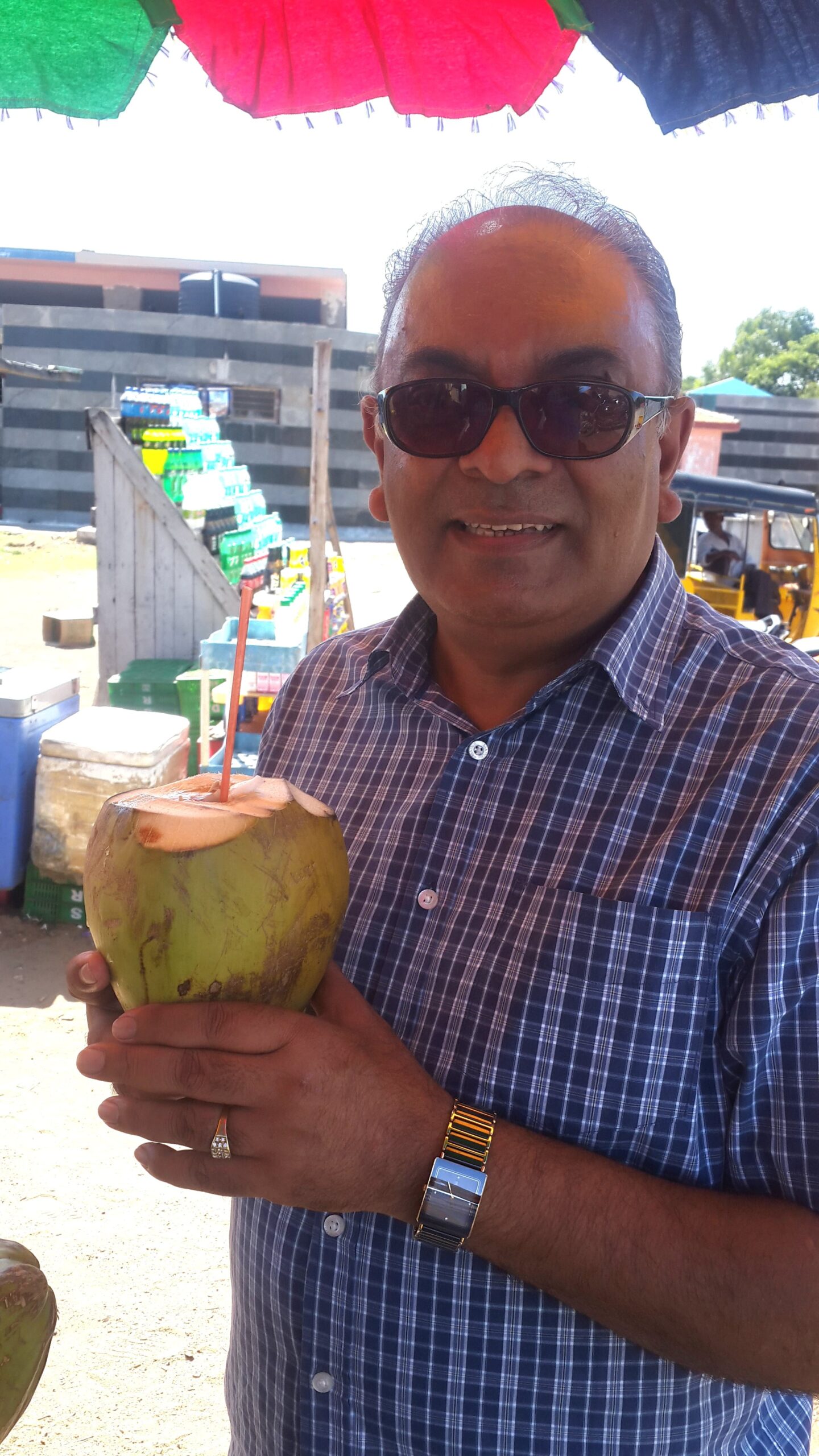
From there we went to see the lighthouse, where we sat and enjoyed fresh madafu with malai — tender coconut water and soft coconut flesh — along with freshly fried cassava chips sprinkled with lemon juice and red chilli powder. Sitting by the sea with those flavours and that view brought back old memories in a way no museum ever could.
Later we went to see the Likoni ferry from a distance, though we did not go too close because of heavy traffic. In our childhood we too had crossed by this ferry. In those days it had been much smaller. Now it is large and carries thousands of passengers as well as cars and trucks, especially labourers who live outside Mombasa island and travel in daily.
We then drove past the Nyali Beach area, where many Indians have now moved. There we saw a beautiful and peaceful Shiva temple that appeared in one of the caves along lovely Nyali Beach.
During our childhood, Bamburi Beach had often been a favourite place to visit when in Mombasa. We therefore went there with high expectations. Sadly, the reality was disappointing. What had once been a beautiful beach was now overcrowded and full of wet and dry seaweed. We had some cold drinks there, but before long decided to return to Diani before it grew dark.
After resting at the resort, we went out in the evening to Punjab Restaurant for an Indian meal. Unfortunately, the food was prepared by locals rather than Indian chefs, and it was bland — not at all to our usual spicy taste. Yet by then we were learning an important truth of travel: not every detail needs to be perfect when the larger journey is so meaningful.